Supporting The UN Sustainable Development Goal No 2: Zero Hunger
The Butterfly Tree provides funding for the following food security projects:
- emergency food relief
- schools to create sustainable feeding programmes.
- sustainable income-generating enterprises for women.
- sustainable income-generating enterprises to empower young people with physical and mental health challenges.
See How We Have Helped With Food Security So Far
In 2024, Zambia was ranked 115/127th on the GHI (Global Hunger Index)

Muskokotawne womens project – october 2024
We donate seeds and fertilizer to schools to support sustainable feeding programmes. Seven schools have received water reticulation systems. In addition we have initiated projects for women to create food security and sustainable income-generating enterprises at Muyunda, Senkobo, Musokotwane, Sekute, and Siambelele. Four more groups were offered projects in 2024 to women in Zalu, Zwanga, Kanchele and Sekute Central. Each group received a borehole and water system, training, tools, and seeds and fertilizer to provide food for their own consumption and for sustainable income-generation. In January 2025 each of the four groups will receive a storeroom and grinding mill.
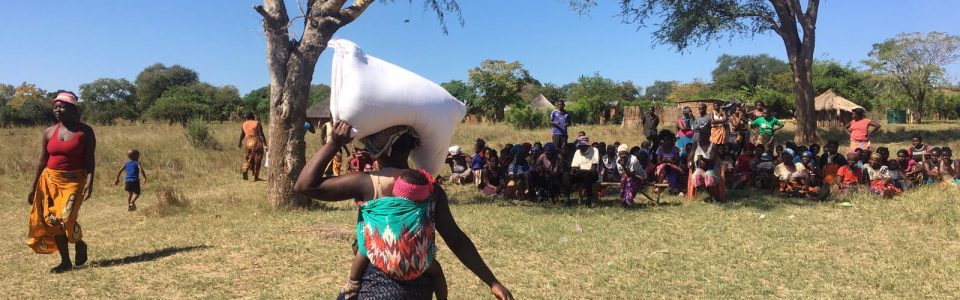
Emergency food relief – October 2024
Three villages, Mukuni, Ngandu and Kamwi, were selected in 2023 to initiate food security and sustainable income-generating enterprises for young people with physical and mental health challenges. There is very little available for these vulnerable young people.
As hunger became more widespread The Butterfly Tree reached out to the most vulnerable people in Mukuni, Sekute, Musokotwane, Nyawa and Moomba Chiefdom. We donating thousands of bags of ground maize using our volunteers on the ground.

Food crisis – November 2019 to February 2020
Zambia is again suffering from a severe drought mainly caused by El Nino phenomenon. Unlike the drought in 2019 which mainly affected the Southern and Western Provinces this drought 84 out of 117 districts according to the government crop assessment data. This report Final report-Zambia_Food Security Drought Response Plan 18042024_14 months FINAL published by Zambia’s Disaster and Management and Mitigation Unit, published in May 2024 details the critical situation.
To help people in the Kazungula District this year The Butterfly Tree has installed 23 boreholes, water systems and several food security projects for women and young people with disabilities. In addition we are distributing ground maize to those most in need in four Chiefdom – Mukuni, Nyawa, Musokotwane and Sekute.
Food crisis – March to October 2019
Southern and Western Provinces of Zambia are suffering from a severe drought, virtually no rain has fallen during this season. I saw the devastating effect taking place in the Southern Province in March – rivers and streams are dry and crops have perished. By October I saw signs of hunger in every area where we work. No rain is expected until November/December. Many people in rural areas are eating only one meal a day, others relying on neighbours to share their food, some eating only wild food and wild roots.

Zambia ranks third hungriest nation in 2016
Numerous challenges burden the country, including high rates of malnutrition, poverty, food insecurity, HIV and AIDS and malaria. While Zambia has reduced the rate of extreme poverty in some areas, extreme poverty continues to be much higher in rural areas (57 percent) compared to urban areas (13 percent ). Zambia’s food security challenges are worsened by a high dependence on rain-fed agriculture. This is attributed to localized poor crop production due to poor weather conditions in some parts of the country.
The stable diet for Zambians is maize, which is heavily dependent on rain. The rainy season in Zambia runs between November and April, seeds are planted in November. Too much rain and the seeds rot, insufficient rain results in poor crops.
Food shortages are apparent in rural areas throughout southern province
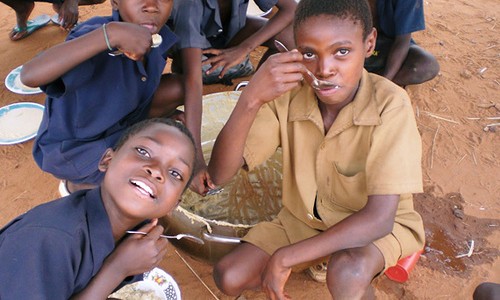
Sixteen schools annually receive seeds and fertilizer to enable them to grow their own produce. Maize is dried and stored for the long ‘dry’ season, vegetables and beans are grown using the bore hole water we have provided for drinking and irrigation.
Sadly 2014-15 saw a poor rainy season and alarmingly 2015-16 is following in the same path. Areas drought and unseasonably high temperatures are being reported in the Southern Province. Last year most maize crops in the Southern Province perished as the crops are rain dependent. We have encouraged schools to grow sorghum, which is less rain dependent as well as more vegetables. Water from bore holes can be used to irrigate school gardens, especially when the river and streams run dry. Our aim is continue to raise funds to enable more schools to initiate sustainable feeding programmes.